How to Lose $20 Billion in Two Days
The Spectacular Collapse of Bill Hwang and Archegos Capital
August 10, 2023
Executive Summary
In March 2021, Bill Hwang, a little-known family office manager, erased roughly $20 billion of his personal fortune in just days as his highly leveraged bets on a handful of stocks unraveled. The fallout also inflicted billions in losses on several global banks, turning what began as a single investor’s margin calls into one of the most dramatic implosions in modern financial history.
Operating through total return swaps that kept his identity hidden, Hwang had built an estimated $20 billion+ position across a concentrated basket of U.S. and Chinese media and technology names. When those stocks reversed sharply, prime brokers demanded additional collateral. Hwang’s refusal to reduce positions triggered forced liquidations that rippled across Wall Street.
The episode highlighted the risks of opaque leverage in family offices and the potential for one concentrated player to create systemic stress, even if broader contagion was ultimately contained.
Key Takeaways
- Bill Hwang turned roughly $200 million into more than $20 billion in under seven years through aggressive concentration and heavy leverage.
- Archegos Capital used total return swaps to amass massive undisclosed positions, remaining largely invisible to regulators and the market.
- A ViacomCBS equity offering on March 22, 2021 triggered sharp declines in Hwang’s core holdings, sparking margin calls he ultimately could not meet.
- Global banks suffered an estimated $10 billion in combined losses, with Credit Suisse hit hardest at $5.5 billion.
- The episode exposed weaknesses in prime brokerage risk management and prompted renewed scrutiny of family office disclosure rules.
- Despite the scale of the collapse, the financial system showed resilience with no wider contagion.
Event Overview
On March 22, 2021, media conglomerate ViacomCBS announced a $3 billion stock and convertible bond offering. The move proved disastrous for Bill Hwang, whose family office, Archegos Capital Management, held an outsized long position in the stock. Over the following days, ViacomCBS shares plunged more than 25%, triggering margin calls across Hwang’s prime brokers.
When Hwang declined to post additional collateral or unwind positions voluntarily, the banks began forced liquidations. Block trades totaling nearly $10 billion hit the market on a single Friday, hammering stocks including ViacomCBS, Discovery, and several Chinese technology names. The rapid selling created a feedback loop that accelerated losses for both Archegos and its lenders.
Background and Context
Born in South Korea to a pastor father, Bill Hwang immigrated to the United States at age 18. After working night shifts at McDonald’s and earning degrees from UCLA and Carnegie Mellon, he entered finance via Hyundai Securities before joining the ranks of Julian Robertson’s “Tiger Cubs.”
His first hedge fund, Tiger Asia, grew to manage $10 billion but was forced to close in 2012 after insider trading charges. Hwang then pivoted to a family office structure with Archegos, investing primarily his own capital. Concentrated bets on technology and media stocks, amplified by substantial leverage through total return swaps, propelled his fortune from roughly $200 million to more than $20 billion in less than seven years.
Hwang maintained a low public profile and modest personal lifestyle in suburban New Jersey, while his trading activity remained obscured by the use of swaps arranged with multiple prime brokers.
Why It Matters
The Archegos episode is notable not only for the speed and scale of value destruction — approximately $30 billion wiped out in a week — but for the way a single concentrated family office created significant losses for sophisticated global banks. It underscored the potential for “invisible whales” to exert outsized influence on markets without triggering conventional disclosure requirements.
For macro and financial market participants, the case serves as a cautionary tale about concentration risk, leverage, and the challenges of monitoring risk when positions are routed through derivatives and prime brokerage relationships.
Strategic and Economic Implications
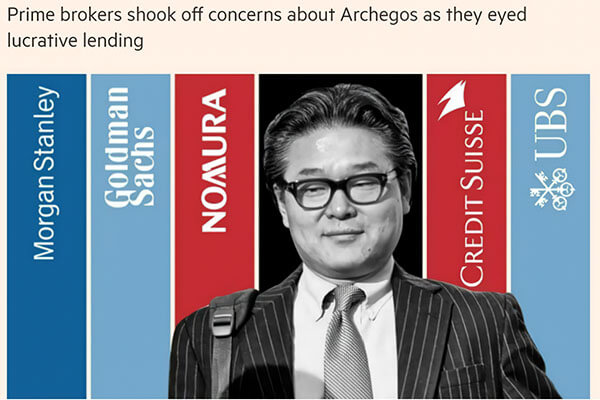
Several banks faced substantial hits: Credit Suisse reported losses of about $5.5 billion, while Nomura lost more than $2.5 billion. Goldman Sachs, Wells Fargo, and Deutsche Bank emerged relatively unscathed after moving quickly to reduce exposure.
The episode highlighted vulnerabilities in prime brokerage practices and the potential for forced selling to amplify market moves. Although no systemic crisis ensued, the event prompted regulators and lawmakers to examine whether family offices should face the same transparency rules applied to hedge funds.
For investors and wealth managers, the story illustrates how faith-driven conviction and aggressive doubling-down — without adequate hedging — can transform substantial gains into catastrophic losses when market conditions shift.
Archegos Collapse Snapshot
| Factor | Current Situation (2021) | Strategic Implication |
|---|---|---|
| Peak AUM / Notional Exposure | ~ $20+ billion personal fortune | Extreme concentration in few names |
| Primary Instrument | Total return swaps | Allowed anonymity and high leverage |
| Trigger Event | ViacomCBS equity offering March 22 | Rapid 25%+ decline in core holdings |
| Bank Losses | ~ $10 billion total | Credit Suisse most exposed at $5.5B |
| Disclosure Regime | Limited for family offices | Calls for enhanced transparency post-event |
Risk Factors and Watchpoints
The Archegos case raised questions about the adequacy of risk controls at prime brokers when dealing with family offices. Key risks included over-reliance on a small number of concentrated positions, insufficient hedging, and the potential for synchronized margin calls across multiple lenders to create fire-sale conditions.
Regulators continue to assess whether similar opaque structures could pose future stability concerns, particularly if leverage levels remain high and disclosure remains limited.
Conclusion
The rapid collapse of Archegos Capital stands as a stark reminder of the fragility that can accompany fortunes built on heavy leverage and concentrated bets. Bill Hwang’s journey — from immigrant to one of the wealthiest individuals on Wall Street, and back — illustrates both the power and the peril of conviction-driven investing.
While the financial system absorbed the shock without broader contagion, the episode exposed gaps in visibility and risk management that warrant continued attention. For market participants, the lesson remains clear: even the most successful strategies can unravel with devastating speed when market sentiment turns and leverage works in reverse.
As investors seek to build and protect wealth in an evolving global landscape, maintaining disciplined risk frameworks alongside any wealth-building strategies and clear communication practices remains essential. Ongoing monitoring of regulatory developments around family office transparency will be critical in the years ahead.