Weekly Market Recap: (November 30 – December 5, 2025)
Why do markets often thrive amid uncertainty? This week’s global economic narrative offers a telling case study. Investors witnessed a peculiar blend of resilience and contraction, with economic data painting a mixed picture. Manufacturing struggles in key economies like China and the US contrasted with surprising strength in services sectors and labor markets. Meanwhile, central banks loomed large, with speculation of rate cuts from the Federal Reserve adding a layer of intrigue. As cautious optimism prevailed, major stock indices posted modest gains, driven by AI-driven tech sectors and dovish monetary policy expectations.
| Date | Currency | Event | Actual | Forecast | Previous | Notes |
|---|---|---|---|---|---|---|
| Nov 30 | CNY | Manufacturing PMI (Nov) | 49.2 | 49.2 | 49.0 | Matched forecast but remained in contraction territory, signaling ongoing weakness in Chinese manufacturing. |
| Dec 1 | AUD | Company Gross Operating Profits (QoQ) (Q3) | 0.0% | 1.7% | -2.6% | Significant miss, indicating stagnation in Australian corporate profits. |
| Dec 1 | CNY | Caixin Manufacturing PMI (Nov) | 49.9 | 50.5 | 50.6 | Miss, further confirming slowdown in China’s private sector manufacturing. |
| Dec 2 | USD | ISM Manufacturing PMI (Nov) | 48.2 | 49.0 | 48.7 | Miss, highlighting continued contraction in US manufacturing sector. |
| Dec 2 | EUR | CPI (YoY) (Nov) | 2.2% | 2.1% | 2.1% | Slight beat, suggesting persistent inflationary pressures in Eurozone. |
| Dec 2 | EUR | Unemployment Rate (Oct) | 6.4% | 6.3% | 6.4% | Miss, indicating a slight deterioration in labor market conditions. |
| Dec 3 | AUD | GDP (QoQ) (Q3) | 0.4% | 0.7% | 0.7% | Notable miss, reflecting slower-than-expected economic growth in Australia. |
| Dec 3 | CHF | CPI (MoM) (Nov) | -0.2% | -0.1% | -0.3% | Miss, showing deeper deflationary trends in Switzerland. |
| Dec 4 | USD | ADP Nonfarm Employment Change (Nov) | -32K | 5K | 47K | Major miss, raising concerns about US labor market softening. |
| Dec 4 | USD | ISM Non-Manufacturing PMI (Nov) | 52.6 | 52.0 | 52.4 | Beat, indicating expansion in the US services sector. |
| Dec 4 | USD | Crude Oil Inventories | 0.574M | -1.900M | 2.774M | Unexpected build, potentially pressuring oil prices. |
| Dec 5 | JPY | Household Spending (YoY) (Oct) | -3.0% | 1.1% | 1.8% | Significant miss, pointing to weakening consumer demand in Japan. |
| Dec 5 | USD | Initial Jobless Claims | 191K | 219K | 218K | Strong beat, suggesting resilience in the US job market despite other signals. |
| Dec 5 | CAD | Ivey PMI (Nov) | 48.4 | 53.6 | 52.4 | Miss, signaling contraction in Canadian business activity. |
Let’s unravel the week’s key developments region by region, dissecting their implications for markets and the global economy.
Asia-Pacific: Manufacturing Woes and GDP Disappointments

The week began with lackluster data from China, setting a subdued tone for Asian markets. On November 30, China’s official Manufacturing PMI stagnated at 49.2—below the critical 50-point threshold that separates expansion from contraction. Non-Manufacturing PMI also disappointed at 49.5, signaling broader economic challenges stemming from trade tensions and sluggish domestic demand. Even the Caixin Manufacturing PMI on December 1 underwhelmed at 49.9, missing forecasts of 50.5. As a result, Chinese equities remained stagnant, with the Shanghai Composite barely moving at +0.01%. Investors now await potential stimulus measures to reinvigorate growth.
Australia offered a mixed bag of economic signals. While manufacturing showed modest expansion with Judo Bank’s PMI finalizing at 51.6 on December 1, other data painted a less rosy picture. Building approvals plunged by 6.4% month-over-month on December 2, far worse than the expected 4.3% decline. Meanwhile, Q3 GDP growth disappointed at 0.4% QoQ (vs. 0.7% forecast) and 2.1% YoY (vs. 2.2%). Company profits stagnated at 0%, missing expectations of 1.7%. However, trade balance figures on December 4 offered a silver lining, improving to AUD 4.385 billion, albeit slightly below forecasts.
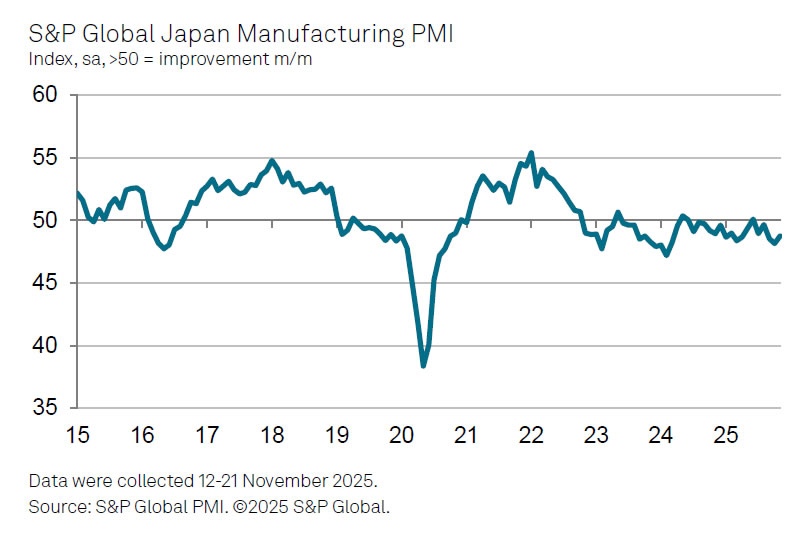
Japan’s economic data reflected a similar pattern of mixed performance. The au Jibun Bank Manufacturing PMI remained in contraction territory at 48.7 on December 1, while Services PMI on December 3 showed strength at 53.2. However, household spending on December 5 plunged to -3.0% YoY—far below the expected 1.1% growth—raising questions about consumer confidence and its implications for Bank of Japan policy.
Market Impact: Asian indices traded sideways as weak Chinese demand weighed on commodities like iron ore. The Australian dollar softened slightly against the US dollar, reflecting subdued sentiment.
Europe: Inflation Eases Amid Services Sector Resilience
In Europe, inflation trends provided some relief but highlighted persistent challenges in the labor market. Eurozone CPI rose 2.2% YoY in November (slightly above the forecast of 2.1%), while Core CPI held steady at 2.4%. However, monthly figures revealed deflationary pressures: CPI fell -0.3% MoM, with Core CPI down -0.5%. Unemployment ticked up to 6.4% in October, marginally exceeding expectations of 6.3%.

On the business activity front, the HCOB Eurozone Manufacturing PMI finalized at 49.6 on December 1, remaining in contraction territory but close to expectations. In contrast, Services PMI on December 3 outperformed at 53.6 (vs. 53.1 expected), driving the Composite PMI to 52.8—a sign of resilience in the services sector.
The UK saw similar trends, with Manufacturing PMI meeting expectations at 50.2 on December 1 and Services PMI revised upward to 51.3 on December 3. However, housing data showed cracks: mortgage approvals dipped to 65,020 (vs. 64,000 expected), and Nationwide House Prices slowed to a modest 1.8% YoY growth despite a monthly increase of 0.3%. Construction PMI delivered a shocker on December 4, plummeting to a dismal 39.4 (vs. expectations of 44.5), underscoring challenges in the sector.
Swiss Retail Sales bucked the trend with a surprising 2.7% YoY increase on December 1, but CPI data on December 3 revealed deflationary pressures.
Market Impact: European markets edged higher amid optimism surrounding services sector growth and easing inflationary pressures. The FTSE 100 rose by a modest 0.17%, reflecting cautious sentiment.
US: Labor Market Strength Fuels Optimism
The US economy continued its delicate balancing act between cooling inflation and resilient labor markets—a dynamic closely watched by investors ahead of potential Federal Reserve rate cuts.
Job market data provided a bright spot this week: initial jobless claims fell to their lowest level since mid-2025, signaling ongoing labor market strength despite broader economic headwinds. Inflation indicators showed further cooling, reinforcing expectations that the Fed could pivot toward rate cuts in early 2026.
Major stock indices reflected this cautious optimism: the S&P 500 gained 0.67%, the Dow Jones Industrial Average climbed 0.89%, and the Nasdaq Composite advanced by 0.60%. Tech stocks led the charge, buoyed by enthusiasm for AI-driven innovations and dovish monetary policy expectations.

Market Impact: US equities outperformed global peers as investors embraced signs of economic resilience paired with hopes for monetary easing.
Key Takeaways and What Lies Ahead
This week’s market movements underscore a recurring theme: resilience amid uncertainty can fuel cautious optimism among investors, even when economic data presents a mixed picture.
- China’s Struggles Persist: Manufacturing contraction and weak demand continue to weigh heavily on Asia-Pacific markets.
- Europe’s Inflation Relief: Easing inflation offers hope but is offset by labor market challenges and sluggish construction activity.
- US Optimism: Strong labor market data and cooling inflation have set the stage for potential Federal Reserve rate cuts.
As we look ahead, all eyes remain on central banks worldwide as they navigate this complex economic landscape. Will policymakers embrace dovish stances to support growth? Or will persistent risks—ranging from geopolitical tensions to structural economic issues—demand caution?
For investors, the coming weeks may offer clarity—or more questions—about where global markets are headed in this era of uncertainty.
What do you think? Are we witnessing a turning point for global markets or merely a temporary pause in broader volatility? Share your thoughts below!